

BUILDING 3D CELL MODELS –THE WONDERFUL WORLD OF CELLS
Thanh-Dung Nguyen,
Head of STEM Club, NguyenTrung Truc 1 High School, An Giang province
In the biology curriculum, cells are often presentedthrough dry 2D drawings on the pages of textbooks. However, with the STEM(Science, Technology, Engineering, Mathematics) education method, we cantransform that theoretical knowledge into a creative, hands-on experience:building 3D cell models. This is not just a practical exercise, but a journeyof discovery into the "basic unit of life" from the perspectives ofboth an engineer and an artist.
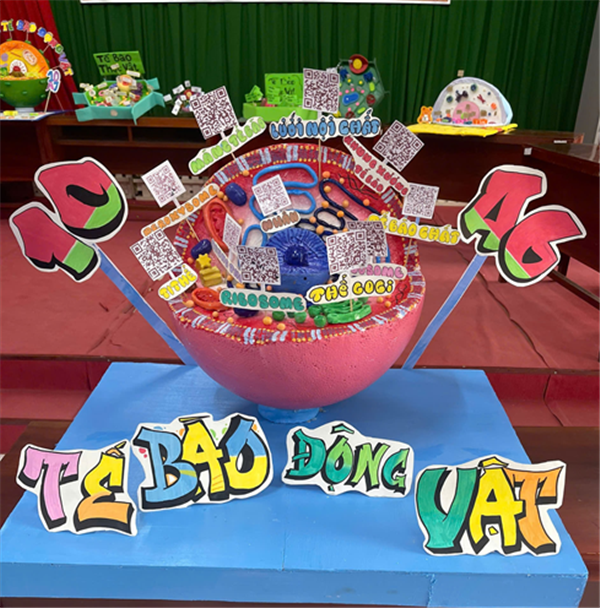
This product was created byclass 10A6
* Scientific Idea and Goals (Science): Cells arecomplex systems with organelles acting as specialized "factories."The goal of this project is to help students understand the structure andfunction of each component: the cell nucleus (the control center), mitochondria(the energy station), endoplasmic reticulum, Golgi apparatus, and cellmembrane. Observing a three-dimensional model helps learners easily visualizethe spatial arrangement and the close relationships between these parts,something that flat images cannot fully convey.
* Design and Manufacturing Process (Engineering &Technology): To create a 3D cell model, students need to apply engineeringthinking to select materials and assembly methods:
Material Selection: Modeling clay, foam, recycledplastic, or even food ingredients (jelly, gummy candies) can be used.Creativity lies in finding materials with properties similar to organelles (forexample, using small ropes for the endoplasmic reticulum, using beans forribosomes).
Assembly Technique: The person performing the taskmust calculate the proportions between organelles to ensure aesthetics andscientific accuracy. In modern classrooms, the application of 3D printingtechnology or simulation software helps students access real-world industrialproduction processes.
* Mathematics in Biological Structure: Mathematicsplays a crucial role in determining size and volume ratios. Students need tocalculate so that the nucleus is not too large relative to the overall cell, orthat the membrane surface area is sufficient to cover the entire internalstructure. Accurate measurement and cutting of materials help the model becomebalanced and stable.
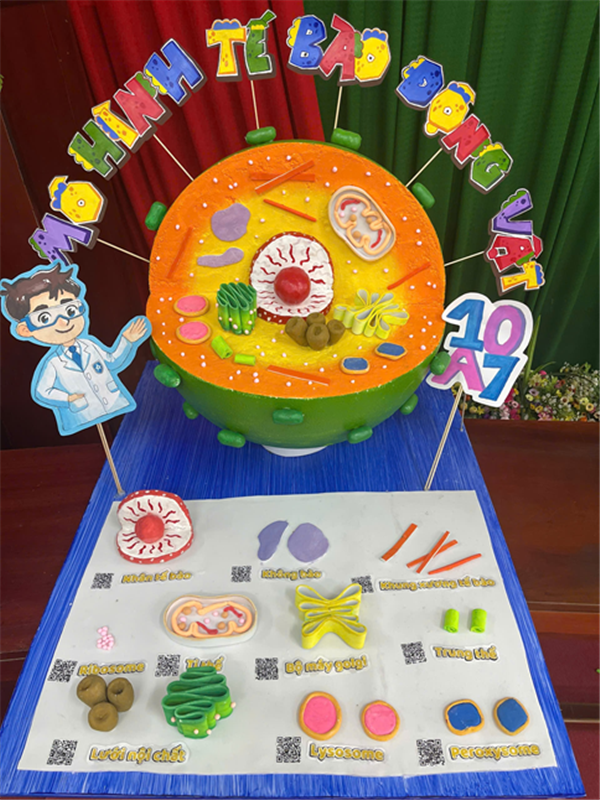
This product was created byclass 10A7
* Value of the Project: The "Wonderful World ofCells" project is not just a display product. It trains students in manyimportant soft skills:
Critical thinking: Why do plant cells have polygonalshapes and rigid cell walls, while animal cells have flexible shapes? Problem-solvingskills: How do organelles stand firmly in a simulated "cytoplasmic"environment? Perseverance and meticulousness: Every small detail contributes tocreating a complete system.
Through the creation of 3D cell models, themicroscopic world of biology becomes more accessible and vibrant than everbefore. This is the core spirit of STEM: learning by doing, using creativity tounravel the mysteries of nature.